
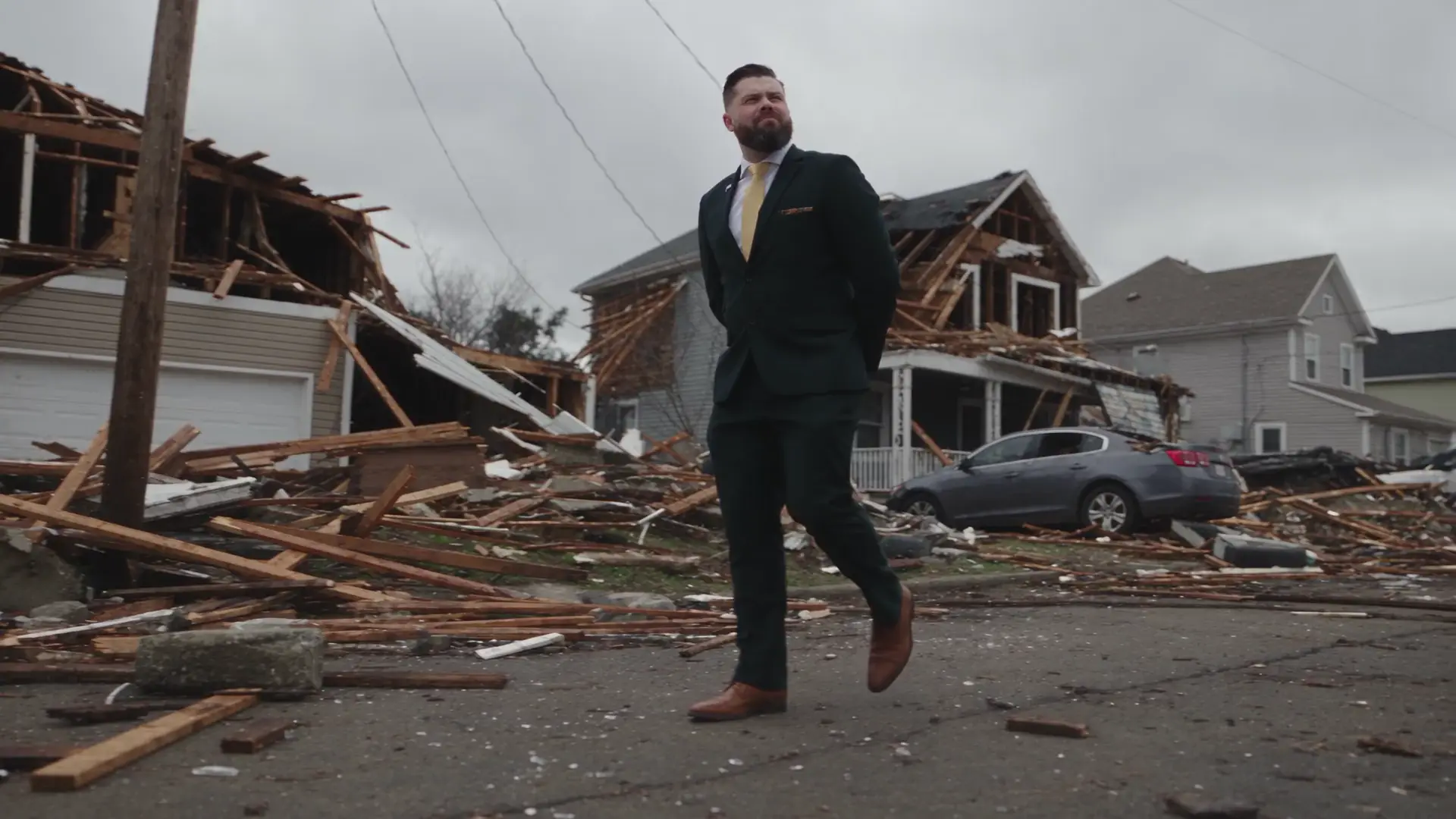
When a tornado devastates your property, dealing with complex insurance claims can quickly overwhelm you while you work to rebuild your life or business. Wind, debris impact, rain, fallen trees, structural movement, utility interruptions, code requirements, temporary housing, and total-loss questions can all become part of your claim.
Our tornado damage insurance claim lawyers represent homeowners and businesses when carriers deny, delay, or underpay tornado losses. Denham Property & Injury Law Firm focuses on the claim-handling disputes that matter after a major storm, including wind-versus-water causation, repair scope, ordinance and law coverage, additional living expenses, and total-loss valuation.
Don’t let the insurance company undervalue your claim. Call (859) 900-BART (2278) or contact us online for a free consultation.
What Does a Tornado Damage Insurance Claim Lawyer Actually Do?

A tornado damage insurance claim lawyer identifies what caused each part of the loss, which policy provisions respond, and whether the carrier’s investigation and estimate reflect the full covered damage. Large tornado claims often fail when multiple causes and coverages are compressed into a single, oversimplified adjustment.
We read the policy and reconstruct the loss. That can include structural damage, roof and exterior failures, interior rain damage, contents, debris removal, detached structures, additional living expenses, business-income losses, code upgrades, and total-loss questions.
A tornado insurance attorney also evaluates how the carrier handled the claim, including inspections, requests for information, delays, changes in coverage position, and payments that leave major categories of covered loss unresolved.
Wind Versus Water Causation Can Decide a Tornado Claim
Tornadoes often create both wind damage and water damage, but those losses do not always fall under the same coverage. The sequence matters, especially when documenting wind damage for insurance claims to distinguish covered wind-related losses from damage caused by water intrusion.
If violent wind tears away roofing or breaks windows and rain then enters through the storm-created opening, the resulting interior damage can involve covered wind-related loss. If water rises from the ground and floods the property, a standard homeowners policy commonly excludes that flooding.
The National Flood Insurance Program explains that most homeowners insurance does not cover flood damage. FloodSmart distinguishes flood coverage from losses caused by other storm forces.
We handle wind versus water causation disputes by tracing how the building was opened, where the water entered, when each condition occurred, and what the policy says about concurrent or sequential causes.
A carrier should not label the entire loss “water damage” when the evidence shows covered wind created the opening that allowed rain inside. This distinction is important when filing a water damage insurance claim, because the cause of the water intrusion can affect whether the resulting damage is covered under the policy.
Total-Loss Valuation Requires More Than One Repair Estimate
A tornado can leave a building standing but economically or legally impractical to repair. Total-loss disputes therefore require more than comparing the carrier’s estimate with a contractor’s estimate.
The analysis may involve structural integrity, demolition needs, building-code requirements, repair feasibility, replacement cost, actual cash value, policy limits, debris removal, and local rules governing damaged structures. Commercial claims can add equipment, inventory, business income, and extra-expense coverage.
| Tornado loss category | Core coverage question | Evidence that can matter |
|---|---|---|
| Building and structure | What direct physical damage did wind or debris cause? | Engineering findings, photographs, repair scope, storm surveys |
| Interior water | Did rain enter through a storm-created opening, or did water rise from the ground? | Opening location, water path, timing, weather evidence |
| Additional living expenses | Was the home unfit to live in because of covered damage, and for how long? | Repair schedule, housing costs, policy limits, carrier communications |
| Ordinance and law | Did rebuilding trigger code-required increased costs covered by an endorsement? | Code requirements, permits, construction scope, endorsement limits |
| Contents or business losses | What covered property or income loss resulted from the tornado? | Inventories, receipts, financial records, valuation support |
When the carrier treats a major structural loss as a series of isolated repairs, important costs can disappear from the estimate. We evaluate the building as a whole and then tie each claimed cost to the policy provision that should respond.
Ordinance and Law Coverage Can Matter After Severe Structural Damage
Rebuilding after a tornado can require compliance with building codes that did not apply when the property was originally constructed. Standard property coverage does not automatically pay every increased cost caused by newer code requirements.
Ordinance and law coverage is designed to address specified increased costs of demolition, reconstruction, or upgrades required by applicable codes, subject to the policy’s terms and limits. The exact coverage varies widely by policy.
The Federal Emergency Management Agency (FEMA) emphasizes the role of current building codes in reducing disaster risk. For an insurance claim, the separate question is whether your policy purchased coverage for the extra cost of complying with those requirements.
We compare the code requirement, construction scope, and ordinance-and-law endorsement instead of assuming the base dwelling or building limit absorbs every upgrade.
Additional Living Expenses Can Become a Major Part of a Tornado Loss
When a covered tornado loss makes a home unfit to live in, additional living expense coverage can pay certain increased costs of maintaining a household elsewhere, subject to the policy’s limits and conditions.
The dispute is often not whether the insured left home. It is how long displacement should reasonably last, which expenses qualify, and whether repair delays caused by the claim process are extending the period of restoration.
Temporary housing, additional meal costs, storage, pet arrangements, transportation changes, and other increased expenses may be relevant depending on the policy and circumstances. We document the claimed increase and challenge arbitrary cutoffs that do not match the repair timeline.
For businesses, comparable issues can arise through business-income and extra-expense coverage rather than personal additional living expenses.
When a Tornado Damage Claim Is Denied
A tornado damage claim denied by the carrier usually comes with a stated reason: excluded water, pre-existing damage, wear and tear, insufficient proof, late notice, vacancy, a coverage limitation, or an argument that the claimed repairs exceed storm damage.
The denial has to be tested against the policy and evidence. We examine the exact exclusion, the carrier’s investigation, weather and damage evidence, professional findings, photographs, estimates, and claim correspondence.
A tornado denial can also be partial. The insurer may accept roof damage but deny interior water, pay for one structure but not another, or accept repairs while refusing a total-loss position. Evaluating structural damage from tornadoes helps identify which portions of the loss are supported by the evidence. We isolate each disputed category so one disagreement does not obscure the covered portions of the claim.
Underpayment Is Common When the Scope Is Too Narrow
An insurer does not have to deny the claim to leave the policyholder short. A low estimate can omit entire categories of tornado loss while still appearing detailed on paper.
Common scope disputes include:
- Structural repairs that do not account for hidden or consequential damage.
- Roofing, siding, windows, or exterior components omitted from the estimate.
- Debris removal and demolition costs treated as incidental or capped incorrectly.
- Personal property inventories undervalued or heavily depreciated.
- Code upgrades excluded without analyzing ordinance and law coverage.
- Temporary housing or business interruption cut off before repairs can reasonably finish.
- Detached structures, fencing, or other covered property left out.
The estimate must be read with the policy. A long list of line items is not the same thing as a complete covered-loss valuation.
When Carrier Conduct Becomes a Separate Legal Issue
A coverage dispute and bad faith are not the same thing. An insurer can make an incorrect decision without acting in bad faith. Bad-faith standards and remedies vary by state. Unsupported estimates, ignored evidence, unexplained delay, or shifting reasons may matter, but whether that conduct supports a separate claim depends on the law governing the claim.
No accusation substitutes for proof. The insurer’s own claim file, communications, inspection record, and decision timeline are often central to that analysis.
Tornado Insurance Claims Differ From Ordinary Storm Claims

Tornadoes concentrate extreme forces in a narrow path and can produce catastrophic damage in one location while leaving nearby property comparatively intact. The National Weather Service notes that tornadoes can destroy well-built structures, uproot trees, and turn debris into dangerous projectiles. Its tornado hazard resources explain the destructive forces involved.
From an insurance perspective, that concentrated damage can create complex causation questions. A roof may be removed, walls shifted, windows broken, trees thrown into structures, and rain driven into openings during the same event.
A storm damage claim after a tornado therefore needs a damage map and policy analysis that reflect the event’s sequence, not a generic storm estimate copied from a smaller wind loss.
Kentucky and Tennessee Tornado Claims
Denham Property & Injury Law Firm represents policyholders in tornado-prone regions, including Kentucky and Tennessee. The firm’s Lexington office provides a base for Kentucky matters, while the Nashville office serves Tennessee at 214 2nd Ave N, Ste. 4, Nashville, TN 37201.
Our team handles tornado damage claims in Kentucky under Kentucky-specific policy and claim-handling rules. Tennessee claims require a separate state-law analysis, even when the physical damage looks similar.
The geography can also affect the evidence. Local National Weather Service reports, storm tracks, damage surveys, building codes, and repair markets can help establish what happened and what rebuilding will require.
We use local evidence because it proves the claim, not as decoration. The policyholder still needs a coverage analysis tied to the actual property and governing law.
How We Work a Tornado File
Our team handles residential and commercial tornado matters involving structural collapse, severe roof breaches, business interruption, and disputed total losses. In working these files, we frequently encounter recurring disputes over whether wind or rising water caused interior damage, whether local building codes require full reconstruction, and whether temporary displacement expenses fall within policy limits.
To build a clear, evidence-based record, we engage structural engineers, meteorologists, building code consultants, and cost estimators who independently evaluate the full scope of damage. When we inspect the carrier’s internal claim file, we often find incomplete field notes, initial estimates that omit crucial structural line items, and delayed decision timelines that fail to reflect the true severity of the storm loss.
Rebuilding Evidence After a Major Tornado Loss
Large-loss insurance disputes are won or lost on the quality of the claim record. The record should show not only what was damaged but how the damage connects to the covered event and what it will cost to restore the property.
Depending on the claim, we may work with or review materials from:
- Structural engineers and other qualified building professionals.
- Contractors and estimators who can define repair scope and pricing.
- Roofing, exterior, plumbing, electrical, or mechanical specialists.
- Contents professionals and inventory documentation.
- Fire or utility records when secondary damage occurred.
- Weather data and National Weather Service storm surveys.
- Building officials or code material relevant to reconstruction.
Our role is to organize that evidence around the policy. The carrier should be required to answer the actual proof supporting each disputed category rather than relying on a broad conclusion that the loss was already “fully evaluated.”
Replacement Cost and Actual Cash Value Can Produce Very Different Tornado Payments
A large tornado claim can be confusing when the first payment is far below the cost to rebuild. The gap may come from depreciation, a deductible, policy limits, excluded work, or a replacement-cost condition that has not yet been satisfied. Those are different issues, and they should not be blended together.
Actual cash value is commonly calculated by taking the replacement cost and subtracting depreciation, where the policy permits. Replacement-cost coverage can provide additional payment after repair or replacement requirements are met. The policy controls the timing, documentation, limits, and deadlines for recovering those withheld amounts.
We review the insurer’s estimate line by line to identify what was depreciated, what was omitted, and which amounts are potentially recoverable later. On a total or near-total loss, that review can materially change the amount the policyholder expects to receive during rebuilding.
Appraisal Is Not a Substitute for Every Coverage Dispute
Some property policies contain an appraisal provision for disputes about the amount of loss. Appraisal can be useful when the insurer and policyholder agree that damage is covered but disagree about valuation or scope. It is not designed to decide every legal question about whether coverage exists.
Before invoking appraisal, we examine the policy language and the carrier’s stated dispute. If the insurer is denying causation, applying an exclusion, or reserving a major coverage issue, those questions may need to be addressed separately from the amount of loss.
Client Experience With Complex Property Claims
Policyholders often contact us after months of trying to move a large claim on their own. At that point, they need both technical insurance knowledge and clear communication about what happens next.
“We worked with Bart on a difficult case that involved a roof claim with one of the largest insurance companies in the nation. While the insurance attempted to stall any progress at every turn, Bart had the kind of dogged determination and technical knowledge that resulted in a settlement in our favor. Calm, collected and focused, Bart guided us through a complicated process and got us to the goal we were hoping for. He’s terrific all around, but, if I have to pick an aspect that stood out, I would probably say it’s his negotiation skills: they are out of this world!”
, Theresa M.
Testimonials like this one reflect the commitment we bring to every one of our clients and claims. We stay focused on what the contract covers, what the evidence proves, and what the carrier still has not addressed.
Questions Property Owners Ask After a Tornado Insurance Loss
Does homeowners insurance cover tornado damage?
Standard homeowners policies commonly cover direct physical damage caused by wind, including tornado wind, subject to the policy’s exclusions, deductibles, limits, and endorsements. Coverage can become more complicated when flooding, pre-existing conditions, code upgrades, or other causes are also involved.
What if wind and floodwater both damaged my property?
Wind and flood damage may fall under different policies or exclusions, so the sequence and source of damage matter. We separate wind-created openings, wind-driven rain, rising surface water, and other causes rather than treating every form of water intrusion as the same loss.
Can my insurer declare part of the house repairable when my contractor says it is a total loss?
Yes, carriers and contractors can disagree about repairability. A total-loss dispute can require structural evidence, code analysis, demolition considerations, repair pricing, and the policy’s valuation terms. We review the competing scopes and determine what additional proof is needed to support the claimed loss.
Does my policy pay for a hotel or rental home after a tornado?
A homeowners policy may include additional living expense coverage when a covered loss makes the residence unfit to live in. The policy controls the amount, duration, and qualifying expenses. We review disputes involving temporary housing and increased living costs against the actual repair timeline and coverage purchased.
What if the insurer keeps extending its investigation after a tornado?
An insurer can take additional time when a large claim reasonably requires more investigation, but the governing state’s claim-handling rules still apply. We review the carrier’s explanations, outstanding requests, inspections, and payment of undisputed amounts to determine whether the delay has a legitimate basis.
Can Denham handle a tornado claim for a business?
Yes, Denham handles commercial property claims that fit the firm’s practice. A business tornado loss can involve the building, equipment, inventory, business-income coverage, and extra expenses. Commercial forms differ significantly, so we begin with the specific policy rather than assuming homeowners rules apply.
How much does it cost to talk with a tornado damage insurance lawyer?
Denham Property & Injury Law Firm offers free consultations for tornado-damage insurance disputes we handle. We can review the policy issue, carrier position, and major categories of loss before discussing representation. Call (859) 900-BART (2278) to arrange a claim review.
Make the Carrier Address the Whole Tornado Loss

A major tornado claim should not be reduced to the first estimate, the first inspection, or one coverage label. The right analysis follows each cause of damage, each category of loss, and each policy provision through the entire claim.
Denham Property & Injury Law Firm represents policyholders when tornado claims are denied, delayed, or underpaid. Call (859) 900-BART (2278) or contact us online for a free consultation about your tornado insurance claim.