
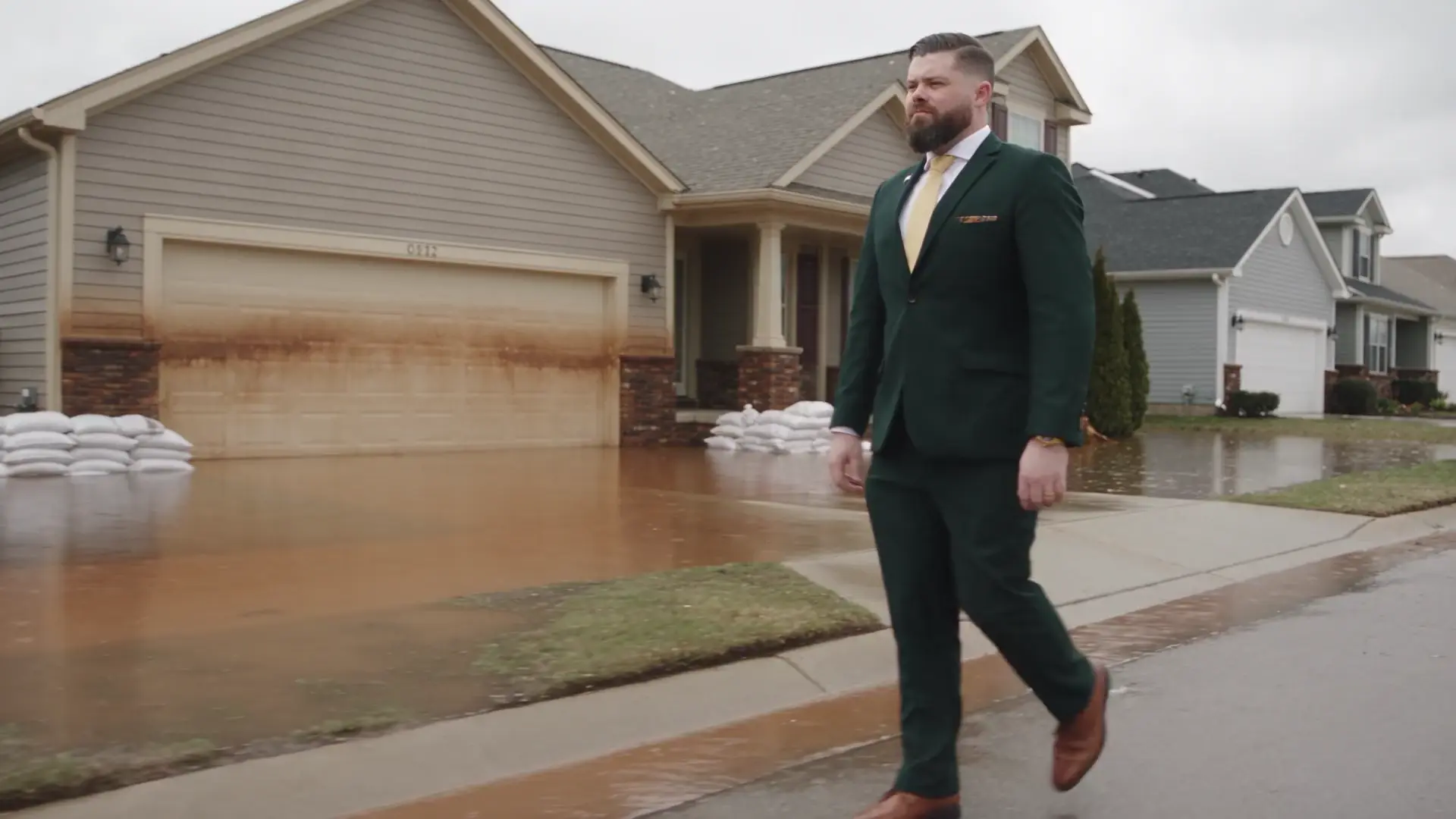
Flood damage creates two problems at once: the property must be repaired, and the insurance rules can be far more technical than most homeowners expect. A flood insurance claim lawyer can identify which policy applies, protect federal or private-policy deadlines, and challenge an insurer that denies or undervalues a legitimate loss.
Denham Property & Injury Law Firm represents homeowners and business owners in flood insurance disputes. We handle National Flood Insurance Program claims, private flood policies, and related coverage disputes when water damage involves more than one possible source.
If your flood insurer has denied all or part of your claim, call (859) 900-BART (2278) or contact us online for a free consultation.

What Does a Flood Insurance Claim Lawyer Do?
A flood insurance claim lawyer handles the legal and coverage issues that arise when the insurer disputes the cause, scope, value, or documentation of flood damage. In an NFIP claim, that also means tracking federal requirements that do not work like an ordinary homeowners claim.
Our attorneys may:
- Review the flood policy and identify the coverage that applies to the building and contents
- Determine whether the loss meets the policy definition of flood
- Compare the insurer’s estimate with the actual physical damage
- Identify proof-of-loss, appeal, and lawsuit deadlines
- Challenge exclusions or valuation decisions that do not fit the policy
- Work with contractors, engineers, accountants, or other professionals when the amount or cause of loss is disputed
- Handle negotiations, a FEMA appeal when appropriate, or litigation when the dispute cannot be resolved
Our NFIP claim attorneys also account for federal rules that can be unforgiving. Missing a requirement under the Standard Flood Insurance Policy can affect payment even when the property clearly flooded.
Flood Insurance and Homeowners Insurance Cover Different Water Losses
Standard homeowners insurance usually does not cover flooding from rising surface water. Flood coverage is typically purchased separately through the National Flood Insurance Program or through a private flood insurer.
That does not mean every large water loss is a “flood” for insurance purposes.
A burst supply line that sends water through a house is different from a river overflowing its banks. Wind-driven rain entering through storm-created roof damage can raise different coverage questions from water rising from the ground. Understanding the policy terms is especially important when pursuing a burst pipe water damage insurance claim, since coverage may differ depending on the source of the water and the circumstances of the loss.
Insurance coverage can depend on how water damage differs from flood damage, including where the water came from and how it entered the property. When both types of damage may be involved, our attorneys trace the source and timing of the water rather than accepting a single broad label from the insurer.
What Counts as a Flood Under an NFIP Policy?
The Standard Flood Insurance Policy uses a specific definition. In general, flood means a temporary condition in which normally dry land is partially or completely inundated across at least two acres or at least two properties, one of which is the insured property.
The water must come from a covered flood source, such as overflow of inland or tidal waters, unusual and rapid accumulation or runoff of surface water, or mudflow. Certain shoreline erosion or collapse conditions can also fall within the definition. Understanding these coverage requirements is important when filing a water damage insurance claim, because not every type of water intrusion qualifies as a covered flood loss.
FEMA’s current NFIP Claims Manual provides claims-handling guidance for NFIP insurers, examiners, and adjusters. It covers the process from notice of loss through final payment, including inspections, damage estimates, coverage decisions, Proof of Loss requirements, and payment of undisputed amounts.
That guidance matters because NFIP coverage depends in part on whether the loss meets the policy’s definition of a flood. A basement flooded by river overflow and one filled by a failed sump pump may look similar after the water recedes, but the insurance analysis can be very different.
| Source of water | Coverage that may apply | Main question |
| Rising river, creek, storm surge, or widespread surface water | NFIP or private flood policy | Does the event meet the policy definition of flood, and what property was directly damaged by floodwater? |
| Burst pipe or failed supply line inside the building | Homeowners or commercial property policy | Was the release sudden, and what resulting water damage does the policy cover? |
| Rain entering through storm-created roof or wall damage | Homeowners or commercial property policy | Did a covered storm event create the opening that allowed water inside? |
| Sewer or drain backup | Depends on policy language and endorsements | Is backup coverage present, and was the water caused by flood or another covered event? |
| Groundwater seepage or long-term moisture | Often disputed or excluded | What caused the moisture, how long was it present, and does any separate covered event apply? |
When there are competing causes, we examine weather records, water lines, drainage patterns, photographs, building damage, and other evidence to determine which policy should respond.
What Is the NFIP Proof of Loss Deadline?
The Standard Flood Insurance Policy generally requires a signed and sworn proof of loss within 60 days after the date of loss. FEMA can extend that deadline for a disaster, but an extension must come from FEMA rather than from an adjuster’s informal assurance.
A proof of loss is more than notice that flooding occurred. It states the amount being claimed and is supported by documentation required under the policy.
The NFIP Claims Manual’s proof-of-loss guidance explains that a late proof of loss generally requires a FEMA waiver before payment can be made.
Our role is to identify the deadline that applies, determine whether FEMA issued an extension for the event, and build the legal claim around the policy requirements.
An adjuster’s inspection and estimate do not necessarily satisfy the policyholder’s own NFIP requirements. You may still need to submit a signed Proof of Loss and supporting documentation within the required deadline, even if the adjuster has already calculated the damage.
What Happens If an NFIP Claim Is Denied?

An NFIP insurer must issue a written denial when it refuses all or part of a claim. That letter matters because it explains the basis for nonpayment and starts important federal deadlines.
If your flood damage insurance claim was denied, we first determine whether the dispute involves coverage, proof of loss, the amount of damage, an excluded item, or compliance with a policy condition.
A partial denial is still a denial of the disputed portion. The NFIP Claims Manual instructs insurers to identify the denied items and explain the basis for the decision rather than relying on vague language. This information can help policyholders understand their options when challenging a denied or underpaid insurance claim.
An insurer may pay an undisputed amount while refusing the rest. Accepting an undisputed payment does not necessarily mean the remaining dispute has disappeared.
Can You Appeal an NFIP Flood Claim Denial?
Yes. An NFIP policyholder who receives a written denial may appeal the decision to FEMA. The appeal must be received within 60 calendar days from the date on the denial letter.
FEMA’s NFIP appeal guidance explains that the appeal is a review of the insurer’s denial, not a way to expand policy coverage or policy limits.
An appeal works best when it directly addresses the reason given for the denial. Our attorneys organize the policy, proof of loss, estimates, photographs, qualified professional findings, and other records around the specific issue FEMA is being asked to review.
The appeal deadline is separate from the deadline to file suit. That difference is one of the most important parts of an NFIP dispute.
How Long Do You Have to File an NFIP Lawsuit?
An NFIP policyholder generally has one year from the written denial to file suit. Filing a FEMA appeal does not pause or extend that one-year period.
The federal appeal rule in 44 C.F.R. § 62.20 specifically warns that an appeal does not extend the time to sue. Federal regulations also address the litigation route in 44 C.F.R. § 62.22.
That means an appeal and a flood insurance lawsuit cannot be treated as consecutive steps with unlimited time between them.
The lawsuit is filed in the federal district court for the district where the insured property is located. If the policy was issued directly by FEMA, the action is against FEMA. A Write Your Own carrier is sued when it issued the NFIP policy.
We calendar the denial date immediately because later correspondence, supplemental submissions, or another proof of loss generally do not restart the one-year suit period.
Why Are NFIP Claims Different From Private Flood Insurance Claims?
NFIP coverage is governed by federal law and the Standard Flood Insurance Policy. Private flood insurance is a contract issued by a private insurer and is governed by its own language plus applicable state law.
The two types of policies can cover similar physical events while using different forms, limits, exclusions, valuation rules, and dispute procedures.
That is why the first question in a flood dispute is not simply, “How much damage is there?” It is, “Which policy issued the coverage, and what rules govern this claim?”
Private flood policies may have their own proof-of-loss requirements, appraisal clauses, suit-limitation provisions, or claim-handling remedies. We read those provisions rather than importing NFIP deadlines into a private policy that does not use them.
How We Build a Flood Damage Claim
Flood claims are evidence-heavy because the carrier must separate covered flood damage from pre-existing conditions, excluded property, and damage caused by a different source.
We start by reconstructing the loss:
- Where the water came from and how it entered the property
- How high the water reached and which areas were affected
- What building components and personal property were physically damaged
- Which items the insurer included, excluded, or depreciated
- Whether repair estimates match the actual materials and labor required
- Which federal or policy deadlines control the dispute
We may use photographs, elevation information, contractor estimates, engineering analysis, inventories, receipts, and other records to support the amount claimed.
For a business, the review can also involve commercial building and contents coverage, specialized equipment, inventory, and other policy-specific losses.
When the carrier’s estimate does not match the building, we make the dispute concrete. Instead of saying the payment is “too low,” we identify the rooms, materials, quantities, or covered items the estimate missed.
Flood Claims in Kentucky and Other States

Flood insurance is a national issue, but the property location still matters. Federal NFIP rules apply across the country, while private flood disputes may also turn on the state law governing the policy.
Denham Property & Injury Law Firm is headquartered in Lexington and handles flood insurance claims in Kentucky as part of its broader property insurance practice. We also represent policyholders in other states in disputes involving denied, delayed, and underpaid property insurance claims.
Federal rules govern NFIP claims in Kentucky and every other state. Policyholders generally must follow the same core requirements for submitting a Proof of Loss, appealing a denial, and filing a lawsuit. The property’s location can still affect practical issues such as local flood conditions, repairs, and where the policyholder must file an NFIP lawsuit.
When the claim involves a private flood policy, we also identify the applicable state insurance law before deciding how to challenge the carrier.
When Should You Call a Lawyer About a Flood Claim?
The strongest reason to call is not the size of the water line on the wall. It is that a coverage dispute, deadline, or valuation problem has become important enough that the claim should not be left to informal back-and-forth with the adjuster.
Legal help can be especially useful when:
- The insurer says the event does not meet the policy definition of flood
- The proof-of-loss deadline is approaching or disputed
- The carrier denies part of the building or contents claim
- The insurer attributes damage to pre-existing deterioration
- The estimate omits large areas, materials, or damaged personal property
- FEMA appeal and lawsuit deadlines are running at the same time
- A private flood insurer relies on an exclusion or policy condition you do not believe fits the loss
If you are deciding what to do if your flood claim was denied, call Denham Property & Injury Law Firm at (859) 900-BART (2278). We can review the policy and denial and explain which deadline and dispute process actually applies.
Does Flood Insurance Treat Building and Contents Damage the Same Way?
Flood policies can treat the building and the property inside it as separate categories of coverage. That means a claim can be correctly paid in one category and still be incomplete or disputed in the other.
Building coverage can involve structural components and certain permanently installed items. Contents coverage focuses on eligible personal property. The policy’s limits, valuation rules, exclusions, and location restrictions can differ between the two categories, especially in basements and other below-grade areas.
We separate the claim into the coverage categories that actually apply. If the insurer paid for drywall and electrical work but omitted damaged appliances, furnishings, inventory, or other covered property, we identify whether those items fall under contents coverage and what documentation supports their value.
Commercial flood claims can involve more complicated coverage questions because insurers may treat equipment, inventory, tenant improvements, and other business property differently. Understanding these distinctions is important when pursuing property damage insurance claims, as coverage may vary depending on the type of property damaged and the terms of the policy.
Our flood damage insurance claim attorneys review the policy and the damaged property category by category instead of assuming the insurer should value every loss under the same coverage or settlement rule.
Flood Insurance Questions Property Owners Often Ask Us
Does NFIP flood insurance cover everything in a basement?
NFIP coverage for basements and areas below the lowest elevated floor is limited. Certain building items may be covered, while finished walls, flooring, furniture, and other contents can be restricted or excluded. We review the exact location and item rather than assuming all basement damage is treated alike.
Does an NFIP policy pay replacement cost for my house?
It can, but only when the policy’s replacement-cost conditions are met. Otherwise, building losses may be settled at actual cash value. Personal property is generally adjusted differently. The valuation method can materially change the payment even when the scope of physical damage is not disputed.
What is Increased Cost of Compliance coverage?
Increased Cost of Compliance can provide additional NFIP benefits when a qualifying flood-damaged building must be elevated, demolished, relocated, or, when eligible, floodproofed to comply with floodplain management requirements. It has its own eligibility rules and limit, separate from ordinary building repair coverage.
Does flood insurance have a waiting period before coverage starts?
Often, yes. NFIP policies commonly have a waiting period before new coverage becomes effective, with exceptions for certain transactions and situations. Whether a particular loss falls inside or outside the effective coverage period depends on the policy’s inception date and the applicable exception.
Can my mortgage company be named on the flood insurance check?
If your mortgage company has a financial interest in the property, the flood insurer may include it as a payee on a check for building damage. That can affect how you receive or use the insurance funds, but it does not change how much the insurer owes for covered flood damage.
Do the same federal deadlines apply to private flood insurance?
Not necessarily. Private flood policies are not automatically governed by the Standard Flood Insurance Policy’s federal claims process. The private policy may set different deadlines for notice, proof of loss, appraisal, and lawsuits. We identify the policy type before relying on an NFIP deadline.
Does Denham Property & Injury Law Firm offer a free initial consultation?
Yes. Denham Property & Injury Law Firm offers free consultations. We can review the flood policy and dispute, explain the issues we see, and discuss the legal options that may be available before you decide how to proceed.
Talk With a Flood Insurance Lawyer Before a Federal Deadline Passes

A flood claim can involve building damage, contents, competing causes, a sworn proof of loss, a FEMA appeal, and a federal lawsuit deadline at the same time. Those pieces need to fit together.
If the insurer has denied part of your claim or offered far less than the documented damage, contact Denham Property & Injury Law Firm. Call (859) 900-BART (2278) or contact us online for a free consultation. We will tell you which rules apply and what legal options remain.