

When floodwater damages your home or business, figuring out the repair costs and complex insurance paperwork creates overwhelming stress on top an already difficult situation.
Floodwater can destroy flooring, walls, appliances, equipment, and personal property in a matter of hours. Insurance claims for flood damage encounter problems when a Kentucky property owner learns that ordinary homeowners coverage and flood insurance are not the same thing, or when a government (NFIP) or private flood carrier pays far less than the documented loss.
Denham Property & Injury Law Firm represents policyholders in property insurance disputes, including denied and underpaid NFIP and private flood claims. We review the flood policy, damage documentation, proof-of-loss requirements, estimates, payment calculations, and denial letters so you can see what the carrier accepted and what remains unresolved.
If your flood claim has been denied or underpaid, call (859) 900-BART (2278) or contact us online for a free consultation with our Kentucky insurance claim attorneys.

Does My Homeowners Insurance Cover Flood Damage in Kentucky?
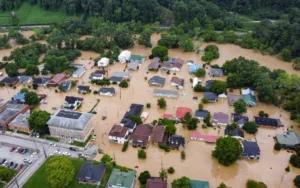
Standard homeowners insurance does not cover flooding caused by rising or surface water. Flood coverage comes from a separate flood policy, including policies issued through the National Flood Insurance Program or by private insurers.
The source of the water matters. A burst pipe, rain entering through a wind-created opening, sewer backup, and a creek overflowing its banks can damage the same room but involve different coverage provisions. Understanding the policy distinctions is especially important when evaluating burst pipe water damage claims, because coverage depends on the cause of the loss and the specific policy language. When wind creates an opening that allows rain to enter, documenting wind damage for insurance claims can help establish how the water entered and what damage resulted.
| Water source | Coverage usually involved |
| Rising river, creek, or surface water | Separate flood insurance, including NFIP or private coverage |
| Burst pipe or appliance leak | Homeowners or commercial property coverage, subject to the policy |
| Rain through a wind-created opening | Wind/property coverage can apply to resulting interior water damage |
| Sewer or drain backup | Coverage depends on the policy and any backup endorsement |
That distinction is why flood versus water damage coverage should be analyzed from the cause outward. The insurer should not label every water loss “flooding” without addressing how the water entered the property and which policy applies.
What Does an NFIP Policy Cover After a Kentucky Flood?
An NFIP policy covers direct physical loss caused by a flood, subject to the Standard Flood Insurance Policy‘s terms, limits, exclusions, and deductibles. Building coverage and contents coverage are separate, so having one does not automatically mean you purchased the other.
Building coverage can apply to insured structural components and specified installed systems. Contents coverage can apply to covered personal property. The declarations page shows the coverage and limits purchased for the property, which are important details to review when evaluating property damage insurance claims.
Basements receive limited treatment under the NFIP. A basement is generally an area with a floor below ground level on all sides, and the policy covers only specified building items and limited categories of personal property in that space.
NFIP coverage also does not pay additional living expenses for a hotel or temporary rental while a flooded home is repaired. Private flood policies can use different terms, so we review the actual contract rather than assume NFIP rules apply to every flood policy.
What Should I Do After Flood Water Damages My Property?
Report the loss promptly and document the property before cleanup changes what the adjuster can see. Flood claims are evidence-heavy, and early photographs can preserve the water line, damaged rooms, affected contents, and conditions that later disappear during mitigation. These records can be especially valuable when filing a water damage insurance claim, helping support the documented extent and cause of the loss.
Useful steps include:
- Take photographs and video of each affected room, exterior flood conditions, the water line, and damaged belongings when it is safe to do so.
- Notify the flood insurer or agent promptly and keep the claim number and adjuster contact information.
- Separate damaged property from undamaged property when practical and safe.
- Prepare an inventory of damaged contents, including descriptions, quantities, approximate ages, and available purchase information.
- Keep repair estimates, mitigation invoices, receipts, photographs, and communications with the carrier.
- Do not discard important damaged items or building materials before documenting them and, when practical, giving the insurer a reasonable opportunity to inspect them.
- Track every deadline in writing, especially any proof-of-loss, appeal, appraisal, or lawsuit deadline.
FEMA’s claims checklist also recommends documenting damage thoroughly and keeping records that support the amount claimed. A complete file becomes especially important when the adjuster’s estimate leaves out rooms, materials, or contents.
NFIP Flood Claims Have Strict Federal Deadlines

An NFIP claim is governed by federal policy terms and federal law. Kentucky’s ordinary property-claim rules should not be substituted for the NFIP deadlines that control proof of loss, FEMA appeals, and lawsuits.
A Kentucky NFIP claim ordinarily requires a signed and sworn proof of loss within 60 days after the loss. FEMA can extend that deadline after major disasters, but a policyholder should not assume an extension exists unless FEMA has issued one that applies to the claim.
| NFIP deadline | General rule |
| Proof of loss | Signed and sworn proof of loss within 60 days unless FEMA extends the deadline |
| FEMA appeal | Generally 60 calendar days from the written denial |
| Federal lawsuit | One year from the written denial or partial denial; an appeal does not extend it |
The one-year lawsuit period is particularly important. FEMA guidance states that an appeal does not extend the time to file suit, and later claim correspondence does not necessarily restart the clock. A missed federal deadline can end a remedy even while the parties are still exchanging documents.
Private flood policies are different contracts. Their notice, proof, appraisal, and suit provisions need to be reviewed separately instead of importing NFIP deadlines into a private-policy claim.
Why Was My Kentucky Flood Insurance Claim Denied or Underpaid?
A flood carrier can dispute whether the event meets the policy definition of flood, whether particular property is covered, or whether the claimed repair cost is supported. When a Kentucky flood insurance claim is denied, the denial should be read alongside the policy and the evidence the carrier used.
Underpayment can be just as serious. The insurer may accept that a flood occurred but dispute quantities, pricing, damaged contents, basement items, pre-existing conditions, or the extent of direct physical damage caused by the flood.
Common disputes include:
- The insurer says the loss did not result from a qualifying flood under the policy.
- The adjuster’s estimate omits damaged rooms, building components, or contents.
- The carrier applies basement limitations to property the policy treats differently.
- The insurer attributes damage to deterioration, prior flooding, or conditions that existed before the loss.
- A proof of loss or supporting documentation is missing, incomplete, or submitted after the applicable deadline.
- The carrier disputes the value, ownership, or flood-related damage to personal property.
- The insurer says another cause, rather than floodwater, produced part of the claimed damage.
A denial or low estimate should be answered issue by issue. We focus on the specific policy provision, damaged property, estimate, and documentation behind each disputed amount.
Eastern Kentucky Flooding Creates High-Stakes Insurance Problems
Eastern Kentucky communities have experienced catastrophic flash flooding, including the July 2022 disaster that led to a federal major-disaster declaration. FEMA’s initial Kentucky declaration included counties such as Breathitt, Clay, Floyd, Knott, Letcher, Perry, and Pike, with additional areas addressed as the response expanded.
A large regional disaster creates practical claim problems beyond the water itself. Contractors and adjusters can be stretched thin, damaged roads can slow access, and property owners may need to document a major loss while dealing with displacement and cleanup.
An Eastern Kentucky flood insurance attorney reviewing a disputed NFIP claim must keep those local facts separate from the federal rules that control the policy. The flood may be local, but NFIP proof-of-loss, appeal, and lawsuit requirements come from federal law and the Standard Flood Insurance Policy.
How Can Denham Help With My Flood Insurance Claim?
We first identify what kind of flood policy you have. An NFIP policy issued directly by FEMA, an NFIP policy administered by a Write Your Own carrier, and a private flood policy can lead to different procedures and legal issues.
Our review may include:
- Reading the declarations, flood policy, endorsements, limits, and deductibles.
- Determining which federal or private-policy deadlines apply to the claim.
- Reviewing the proof of loss and the documents supporting the amount claimed.
- Comparing the adjuster’s estimate with photographs, inventories, repair estimates, and other damage evidence.
- Identifying omitted building items, contents, or flood-related repairs.
- Reviewing basement limitations and other coverage restrictions relied on by the carrier.
- Evaluating a denial, partial denial, supplemental claim, FEMA appeal, appraisal option, or potential lawsuit.
Questions about how NFIP flood claims work become urgent after a denial because the appeal period and the federal lawsuit deadline can run while a policyholder is still supplying documents or disputing an estimate.
We organize the claim around the controlling policy and deadline rather than treating every flood dispute as an ordinary Kentucky homeowners claim.
Why Choose Denham Property & Injury Law Firm for a Kentucky Flood Claim?

Our practice focuses heavily on policyholder-side insurance disputes. Flood claims fit that work because the dispute is usually built from the policy, damage evidence, valuation, carrier communications, and deadlines rather than from a simple disagreement about the amount of water on the property.
Denham Property & Injury Law Firm is headquartered at 250 W Main St., Ste. 2650, Lexington, KY 40507. We represent qualifying Kentucky policyholders, including homeowners and businesses dealing with flood losses in eastern Kentucky and elsewhere in the Commonwealth.
Clients frequently describe the firm as responsive and knowledgeable about insurance disputes. John T. wrote that Bart was “responsive, thoughtful and knowledgeable” after the client had spent nearly a year dealing with an insurer before seeking legal help.
We bring that same attention to the procedural details of flood claims, including documents and deadlines that can have consequences long before a case ever reaches a courtroom.
Questions Kentucky Property Owners Ask About Flood Insurance Claims
Can I Make an NFIP Claim Without a Federal Disaster Declaration?
Yes. NFIP coverage does not depend on the President issuing a federal disaster declaration. If the property has an active NFIP policy and the loss meets the policy definition of flood, you can report the claim directly to the insurer.
What If My Flood Adjuster Missed Damage?
You can submit additional documentation for omitted or misidentified flood damage, subject to the policy and applicable deadlines. Photographs, repair estimates, inventories, receipts, and a properly supported proof of loss can be important when seeking additional payment.
Does NFIP Cover a Finished Basement?
NFIP basement coverage is limited. The policy covers specified building items and a narrow list of eligible personal property in a basement, but it does not treat a finished basement the same way it treats living space above ground level.
Does NFIP Pay for a Hotel While My Home Is Repaired?
No. The Standard Flood Insurance Policy does not provide additional living expense coverage for temporary housing. That differs from many homeowners policies after other covered losses. A private flood policy can contain different benefits, so its terms must be checked separately.
Can I Appeal a Partial NFIP Denial?
Yes. FEMA’s appeal process applies to written denials of all or part of an NFIP claim. The appeal generally must be submitted within 60 calendar days from the date on the denial letter and should directly address the disputed coverage or payment issue.
Does a FEMA Appeal Give Me More Time to File a Lawsuit?
No. FEMA states that an appeal does not extend the one-year federal lawsuit deadline. The suit period runs from the first written denial or partial denial, so the appeal and litigation deadlines have to be tracked separately.
What Should I Bring to a Consultation About a Flood Claim?
Bring the flood policy or declarations page, proof of loss, adjuster estimate, denial letters, payment summaries, photographs, inventories, repair estimates, and important carrier communications. If you do not have everything, we can identify what is missing after reviewing the documents you already have.
Speak With a Kentucky Flood Damage Insurance Lawyer

A flood claim can become more difficult when a policyholder is trying to rebuild while also tracking federal paperwork and deadlines. We can review the policy, proof of loss, estimate, denial, and claim timeline together and identify the issues that need immediate attention.
Call Denham Property & Injury Law Firm at (859) 900-BART (2278) or request a free consultation online. Our Kentucky headquarters is at 250 W Main St., Ste. 2650, Lexington, KY 40507.