
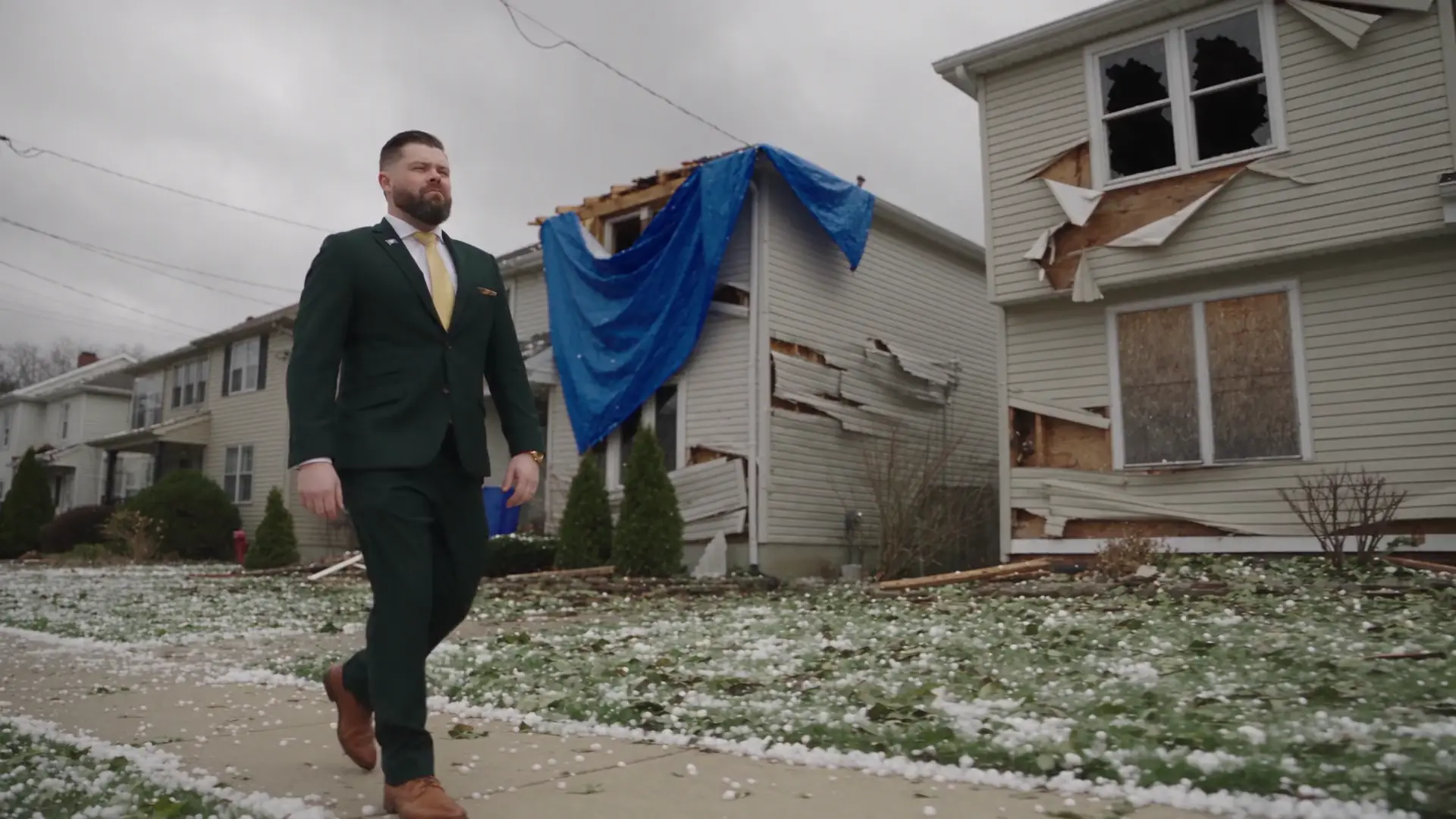
Hail can leave a roof looking mostly intact from the ground while damaging shingles, metal, siding, gutters, windows, and other exterior surfaces. The insurance dispute often begins later, when the carrier says the damage is cosmetic, pre-existing, repairable in a small area, or caused by wear rather than the storm.
Our Kentucky hail damage attorneys represent policyholders in disputed, denied, delayed, and underpaid hail claims. Denham Property & Injury Law Firm reviews the storm evidence, inspection findings, roof condition, policy language, and repair scope together so the carrier’s decision can be tested against the full loss.
Call (859) 900-BART / 859-900-2278 or contact us online for a free claim review.
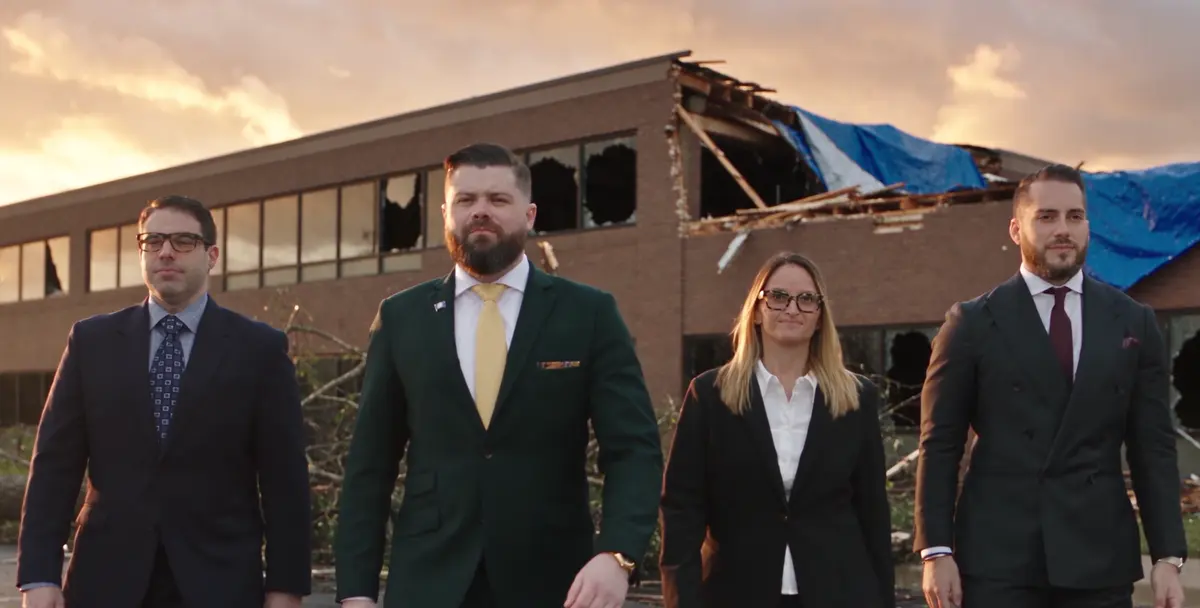
How Can Our Kentucky Hail Damage Attorneys Help With My Claim?
Our Kentucky hail damage attorneys can determine whether the insurer’s coverage position and repair estimate match the policy, the physical evidence, and Kentucky claim rules. We focus on disputed causation, missing repair items, depreciation, matching, and the difference between a spot repair and the work needed to restore a reasonably uniform roof or exterior. We can also help policyholders understand their options when filing a hail damage insurance claim and challenging an estimate that does not account for the full extent of the damage.
Our Kentucky insurance claim attorneys handle hail disputes as insurance cases, not roofing sales disputes. That means the starting point is the contract you purchased and the evidence showing what the storm damaged.
Our Kentucky hail damage lawyers can also help when the insurer has already denied the claim or paid only enough for a limited repair that will not properly restore the damaged area.
Storm Evidence Alone Does Not Prove a Hail Claim
The presence of hail in the area does not by itself prove every mark on a building came from that storm. At the same time, an older roof does not become uncovered simply because it already had ordinary aging. Evaluating the physical evidence after a hailstorm helps distinguish new storm-related damage from pre-existing wear and tear.
Insurers commonly categorize damage as storm impact, mechanical damage, manufacturing defects, installation problems, wear, deterioration, and cosmetic marks. The dispute becomes whether that classification fits what is actually visible and whether the policy covers the resulting physical damage.
The National Weather Service explains that hail can accompany severe thunderstorms and can damage roofs, siding, windows, and vehicles. Its hail safety and hazard information provides useful weather context, while the insurance claim still turns on your policy and property-specific evidence.
How Does Kentucky’s Matching Rule Affect a Hail-Damaged Roof?
Kentucky has a specific matching rule for replacement-cost property claims. 806 KAR 12:095 requires replacement of items in the area when the replacement items do not reasonably match in quality, color, and size, so the repaired area has a reasonably uniform appearance.
The Kentucky Department of Insurance has applied that rule directly to residential roofing. In Advisory Opinion 2023-08, the Department explained that if matching shingles are unavailable for a damaged slope, replacing only that slope with non-uniform shingles can require replacement of the entire roof.
The same opinion also makes an important distinction. If the same shingles are still produced and available, ordinary discoloration from aging does not necessarily require replacement of undamaged areas.
That is why a hail damage roof claim in Kentucky cannot be reduced to “one slope was hit, so one slope is all the carrier owes.” Availability, quality, color, size, policy terms, and the repair area all matter.
| Roof dispute | Kentucky rule or issue | Possible claim impact |
|---|---|---|
| Identical shingles are available | The same product can satisfy matching despite ordinary aging discoloration | Repair may be limited to the covered damaged area |
| Matching shingles are unavailable | Replacement items must reasonably match in quality, color, and size | A larger replacement area may be required for a reasonably uniform appearance |
| Carrier cites roof age | Wear can be excluded, but age does not answer whether hail caused new damage | Causation evidence becomes central |
| One slope is approved | Scope must still account for matching, repair feasibility, and consequential damage | Partial-slope payment may not resolve the full repair obligation |
Matching is a coverage and repair-scope issue, not a promise that every hail claim results in a new roof. We evaluate the rule only after establishing covered damage and the replacement work the policy actually requires.
When Does Hail Damage Require a Full-Roof Replacement?
A roof-replacement dispute usually involves two separate questions: What did hail actually damage, and can the covered repair be completed in a way that satisfies the policy and Kentucky’s matching requirement?
When Matching Shingles Are Still Available
If hail damages only one slope and identical shingles remain available, the insurer may have a stronger basis for limiting replacement to the damaged area. Ordinary fading or discoloration caused by age does not necessarily require replacement of undamaged portions of the roof.
When Matching Shingles Are No Longer Available
If the original shingles are discontinued or unavailable, replacing only one slope may leave the roof without a reasonably uniform appearance. Kentucky’s matching rule can require a broader replacement when available materials do not reasonably match the existing roof in quality, color, and size.
Other Problems Can Make a Partial Repair Impractical
Matching is not the only issue. A limited repair may also become unrealistic because of:
- Brittle shingles that cannot be manipulated without additional damage
- Discontinued or interlocking roofing materials
- Damage to surrounding materials needed to complete the repair
- Flashing, vents, or other components that must be removed and replaced
- Building-code requirements affecting the repair
The policy still determines which of these costs the insurer must cover.
Can an Insurer Deny a Hail Claim Because the Roof Is Old?
Wear, deterioration, and maintenance exclusions can apply to genuine pre-existing conditions. They should not be used as a shortcut to avoid analyzing new hail damage.
A carrier may point to granule loss, blistering, cracking, prior repairs, age, or installation defects. We compare those conditions with impact marks, collateral damage, weather data, photographs, and qualified inspection findings to separate old conditions from the claimed storm loss.
When a hail damage insurance claim in Kentucky is denied for wear and tear, the key issue is causation. Identifying signs of hail damage can help distinguish new storm-related damage from pre-existing wear, allowing the carrier to evaluate whether the storm caused new covered damage even if the property was not brand new before the loss.
What Else Can a Hail Claim Cover Besides Shingles?
A hail claim can extend beyond the roof when the storm damages other covered property. The inspection should match the actual path and intensity of the storm rather than stopping after a quick roof count.
Covered damage may involve:
- Metal roofing, flashing, vents, and ridge components.
- Gutters, downspouts, fascia, and exterior trim.
- Siding and exterior finishes.
- Windows, screens, skylights, and glass.
- HVAC fins and exterior equipment.
- Interior water damage when a covered storm-created opening allowed rain to enter.
The presence of collateral damage can also help establish storm intensity and direction. We compare those findings with the carrier’s scope to determine whether the estimate reflects the whole covered loss.
Why Hail Claims Get Underpaid Even When Coverage Is Accepted

Our Kentucky hail damage attorneys often see claims where the insurer accepts that hail caused damage but still underpays what is needed to repair the property. In those cases, the dispute shifts from whether the loss is covered to the scope of repairs and the value of the claim.
Common underpayment issues include missing slopes, omitted accessories, limited siding quantities, unrealistic labor pricing, depreciation disputes, matching, code-related work, and failure to include consequential damage needed to complete a covered repair.
For broader Kentucky property damage claims, we compare the carrier’s estimate with the policy and a repair scope that reflects the actual work needed. A payment is not necessarily adequate simply because the insurer issued a check.
Kentucky Insurers Have Claim-Handling Duties After a Hail Loss
Hail claims are still subject to Kentucky’s property and casualty claim rules. The insurer must acknowledge a new claim within 15 business days unless it pays within that period and must respond within 15 business days to communications that reasonably call for a response.
806 KAR 12:095 generally requires the carrier to offer amounts due within 30 calendar days after proof of loss. If more time is reasonably needed, the insurer must explain the delay and continue providing written updates while the investigation remains incomplete.
Under Kentucky’s Unfair Claims Settlement Practices Act, KRS 304.12-230, insurers are prohibited from refusing payment without conducting a reasonable investigation.
It is also illegal for an insurer to misrepresent policy terms or provisions. They cannot mislead you about what your policy actually covers, give false explanations for why a loss is excluded, or distort coverage rules to avoid paying a valid hail claim.
If a claim has stalled after repeated inspections or document requests, call (859) 900-BART / 859-900-2278. We can review what the carrier has done and what still needs to be resolved.
Hail Damage Claims in Lexington, Louisville, and Across Kentucky
Denham Property & Injury Law Firm is headquartered at 250 W Main St., Ste. 2650, Lexington, KY 40507 and represents Kentucky policyholders statewide. Hail and severe thunderstorms affect the Bluegrass region, Louisville metro, Northern Kentucky, and communities across the Commonwealth.
The local details matter when they help prove the loss. Storm timing, reported hail size, direction, nearby observations, and the condition of collateral surfaces can all help test whether the carrier’s causation position fits the event.
Our national page explains how hail damage claims work across jurisdictions. A Kentucky claim adds state-specific matching and claim-handling rules that can materially affect the repair dispute.
Replacement Cost, Actual Cash Value, and Hail Deductibles
Hail claims can also turn on how the policy values the loss. Replacement-cost coverage and actual-cash-value coverage do not produce the same initial payment, and some policies use separate wind or hail deductibles that are larger than the standard all-peril deductible. Properly documenting wind damage for insurance claims can help support the reported loss and clarify which policy provisions apply to the damage.
Actual cash value generally reflects replacement cost minus applicable depreciation. Replacement-cost coverage can allow recovery of additional amounts after repair or replacement conditions are satisfied, subject to the policy. We review how the carrier calculated depreciation and whether it applied the correct deductible before treating the first check as the final value.
The deductible should be read together with the declarations and any wind or hail endorsement. A carrier’s estimate can look substantial while leaving a policyholder with a large gap if the deductible, depreciation, omitted work, and matching issue are not evaluated together.
Why Choose Denham Property & Injury Law Firm for a Kentucky Hail Claim?

Hail claims may look like roofing disputes, but the core questions are insurance questions: what the storm damaged, what the policy covers, how much repair is required, and whether the carrier valued the loss correctly. Property insurance disputes are a major focus of our policyholder practice.
Founder Bart Denham is a Lexington native and University of Kentucky law graduate. Before founding the firm, he practiced property-loss litigation with a firm in the Tampa Bay area, giving him direct experience with contested property claims.
Our Kentucky team also includes supervising attorney Adam Hutchinson, who previously defended major insurance carriers, including Progressive, Liberty, and State Farm. He now uses that experience on the policyholder side when insurers deny, delay, or underpay claims.
That background matters in a hail dispute. We examine the carrier’s inspection, roof condition, storm evidence, product availability, matching issues, policy language, and estimate together. When the dispute becomes technical, we focus on the evidence needed to establish causation and the proper scope of repair.
We also explain what the insurer is claiming, what evidence matters, and what comes next. If the carrier approved only part of the damage or proposed a repair that does not appear to restore the covered loss, we can review the claim and explain your options.
What Clients Say About Working With Denham on Property Claims
When insurance companies push back, having dedicated advocates makes all the difference. Our commitment to fighting for policyholders and securing fair outcomes consistently earns praise from clients who have navigated tough disputes with us.
“We worked with Bart on a difficult case that involved a roof claim with one of the largest insurance companies in the nation. While the insurance attempted to stall any progress at every turn, Bart had the kind of dogged determination and technical knowledge that resulted in a settlement in our favor.”, Theresa M.
See how other clients describe their experience working with Denham Property & Injury Law Firm in our client testimonials.
Questions Kentucky Property Owners Ask About Hail Insurance Claims
Does hail damage have to be visible from the ground for insurance to cover it?
No. Covered hail damage does not have to be obvious from the yard. Roof surfaces, vents, flashing, gutters, siding, and other components may need closer inspection. Coverage depends on the policy and whether the evidence shows direct physical loss from a covered hail event.
Can my insurer deny hail damage because my roof is old?
An older roof can have wear or deterioration that is excluded, but age alone does not answer whether hail caused new covered damage. We review the carrier’s inspection, the roof’s prior condition, storm evidence, and policy terms to separate pre-existing conditions from damage caused by the claimed event.
Does Kentucky law require matching shingles after hail damage?
Kentucky’s replacement-cost claim regulation requires a reasonably uniform appearance when replacement items do not reasonably match in quality, color, and size. Whether that requires one slope or a larger roof replacement depends on the covered damage, product availability, and whether an adequate match can actually be achieved.
What if the insurance company says my hail damage is only cosmetic?
A cosmetic-damage position depends on the policy language and what the impact did to the material. Some policies contain cosmetic exclusions or limitations; others do not. We examine the specific endorsement and the physical evidence rather than assuming every visible mark is either covered structural damage or excluded cosmetic damage.
Can I challenge the insurance company’s roof estimate?
Yes, a carrier estimate can be challenged when it leaves out covered work or uses a scope that will not complete the required repair. We compare the estimate with the policy, physical damage, matching requirements, code issues, and qualified repair information to identify the disputed items.
What if the insurer paid for one slope but my shingles are discontinued?
Discontinued shingles can create a matching issue when the replacement material will not reasonably match the remaining roof. Kentucky’s matching rule and the Department of Insurance’s roof guidance are particularly important in that situation. We review product availability and the proposed repair before deciding what additional scope should be pursued.
How much does it cost to talk with Denham about a hail claim?
Denham Property & Injury Law Firm offers free consultations for hail-damage insurance disputes we handle. We can review the carrier’s decision, estimate, policy issue, and key evidence before discussing representation. Call (859) 900-BART / 859-900-2278 to arrange that review.
Get a Clear Review of Your Kentucky Hail Claim

A hail dispute becomes much easier to evaluate when the storm evidence, roof condition, matching issue, policy, and carrier estimate are reviewed together. That is where our Kentucky hail damage insurance attorneys look for the difference between what the insurer paid and what the contract requires.
If your carrier denied, delayed, or underpaid a Kentucky hail claim, Denham Property & Injury Law Firm can review the file. Call (859) 900-BART / 859-900-2278 or contact us online for a free consultation with our hail-damage team.